
Lens selection - the most complex decision in prescription eyewear
KITS
Buying prescription glasses online means making a sequence of decisions most people have never had to make before. What type of vision correction do you need? Which lens tier fits your prescription? Do you have a PD? What happens if you don't? I led the full redesign of KITS' lens selection flow, from intent capture through prescription entry, AI-assisted recommendation, lens technology selection, and order review. The goal was to build something that handles real complexity without making the customer feel it.
Role: Lead Product Designer
With: PM, CTO, Tech team, CS glasses team
Tools: Figma, Figma Make, FigJam, Claude, Google Gemini
+42% more customers entering the lens flow. +28pt lift in lens upgrade rate with AI recommendation. +9.1pt transaction rate increase in the two months after launch.
The problem
Between May 2025 and January 2026, the share of glasses sessions that entered the lens flow dropped from 27.3% to 18.9%, a 31% decline. The gap between customers viewing a product page and actually starting lens selection kept growing. More people were finding frames they liked and then stopping. Add-to-cart fell 4.8 points over the same period. The lens step was where we were losing people, and it was getting worse.
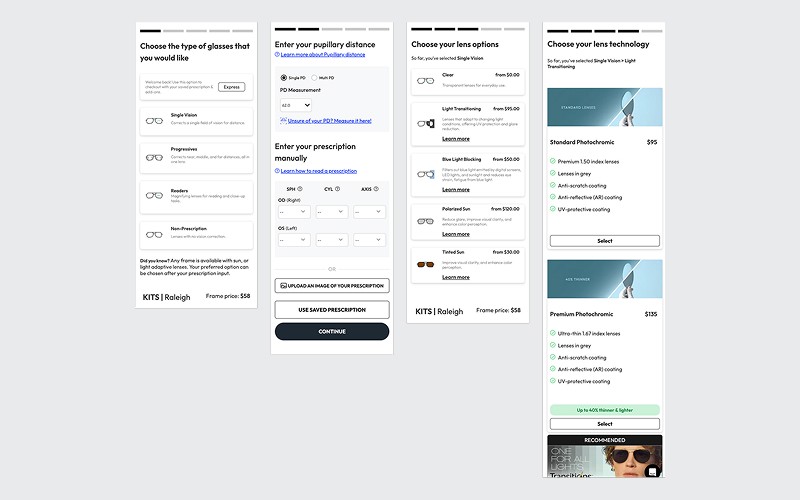
The existing flow handled the happy path well enough. It wasn't built for how prescriptions actually show up in the real world: incomplete data, customers who have never heard the word "SPH," progressives vs readers confusion, or prescriptions that fall outside what we can fulfill online.
Updating UI and logic
First and foremost, I rebuilt the foundation that the flow runs on.
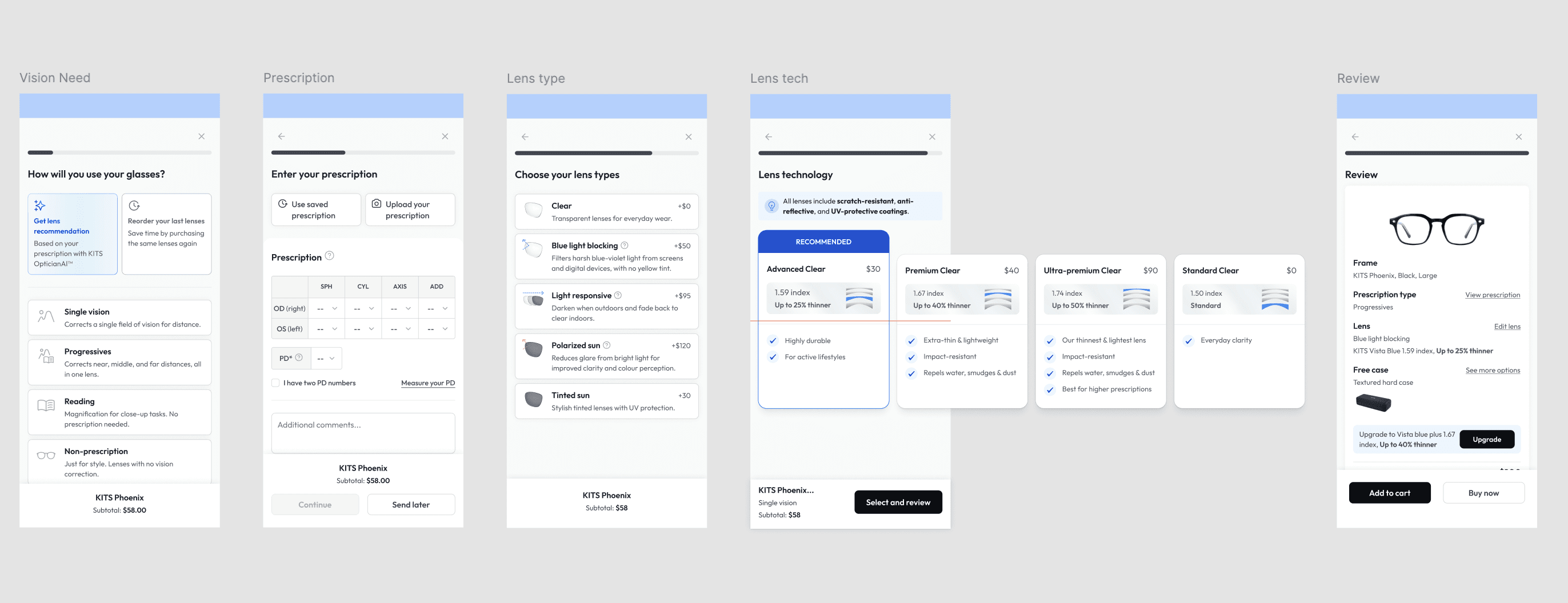
The UI was brought fully in line with the design system, creating a consistent experience across every step. Beyond visual consistency, I introduced dynamic pricing that updates at each step as customers make selections, so they always know what they're paying and why. I also built in a cross-price function that allows the team to test pricing strategies across lens tiers without touching the core flow logic.
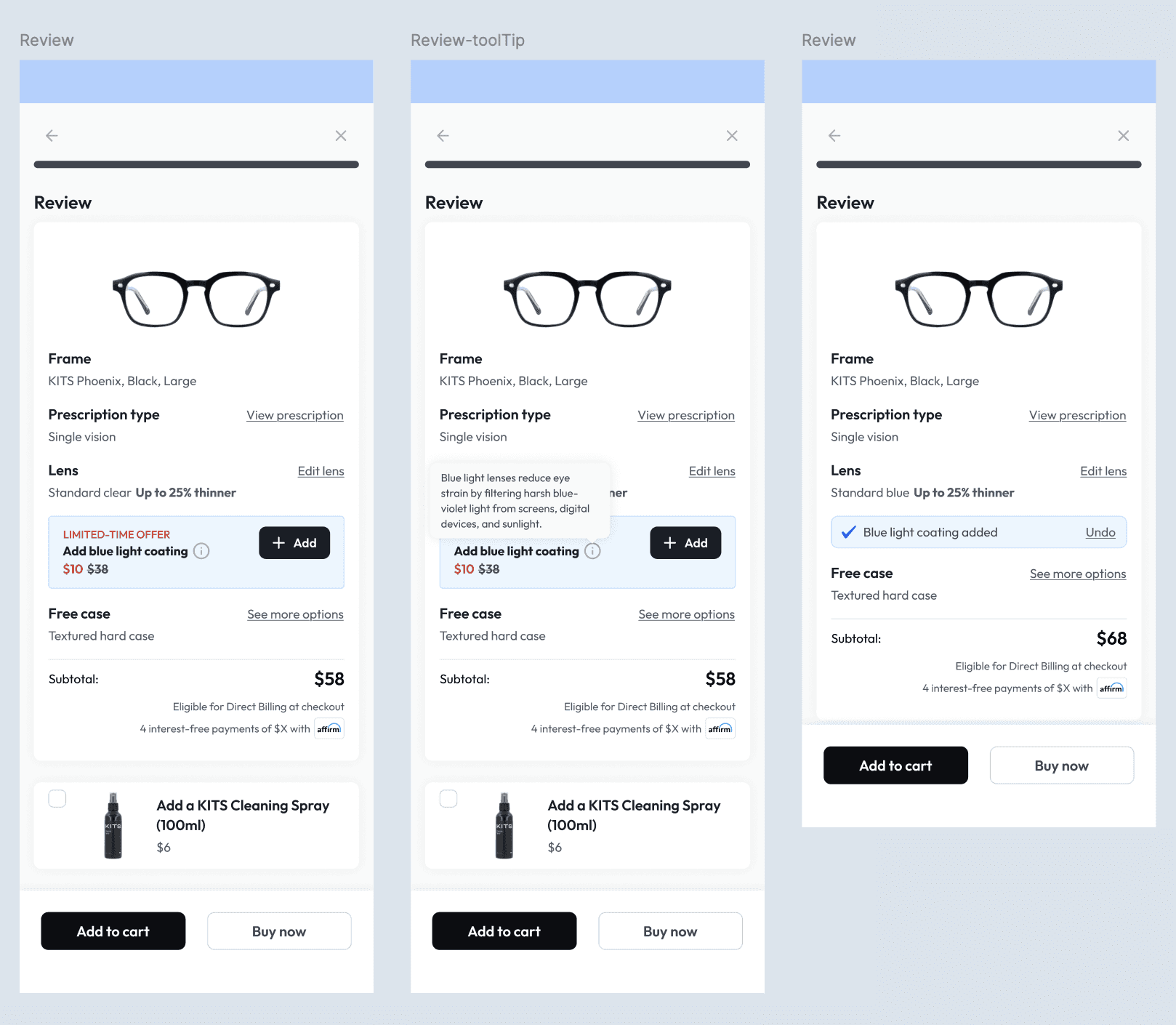
The review step got a significant upgrade too. Instead of a static summary, it now supports add-on upgrade logic, letting customers opt into blue light filtering or thinner lenses at the point of review rather than mid-flow. It keeps the main selection experience focused while still capturing the right upgrade moments before checkout.
Surfacing AI at the right moment
The first screen in the flow asks how a customer will use their glasses. It's the branching point for everything that follows: single vision, progressives, and readers all route differently.
This is where we put the AI entry point.
Rather than waiting for customers to get confused mid-flow, "Get a lens recommendation with KITS OpticianAI" is the first option they see. Manual lens type selection is fully available below for people who want to choose themselves. The decision was intentional: AI assistance works best when it's offered at the moment someone is deciding how to proceed, not after they've already committed to a path.
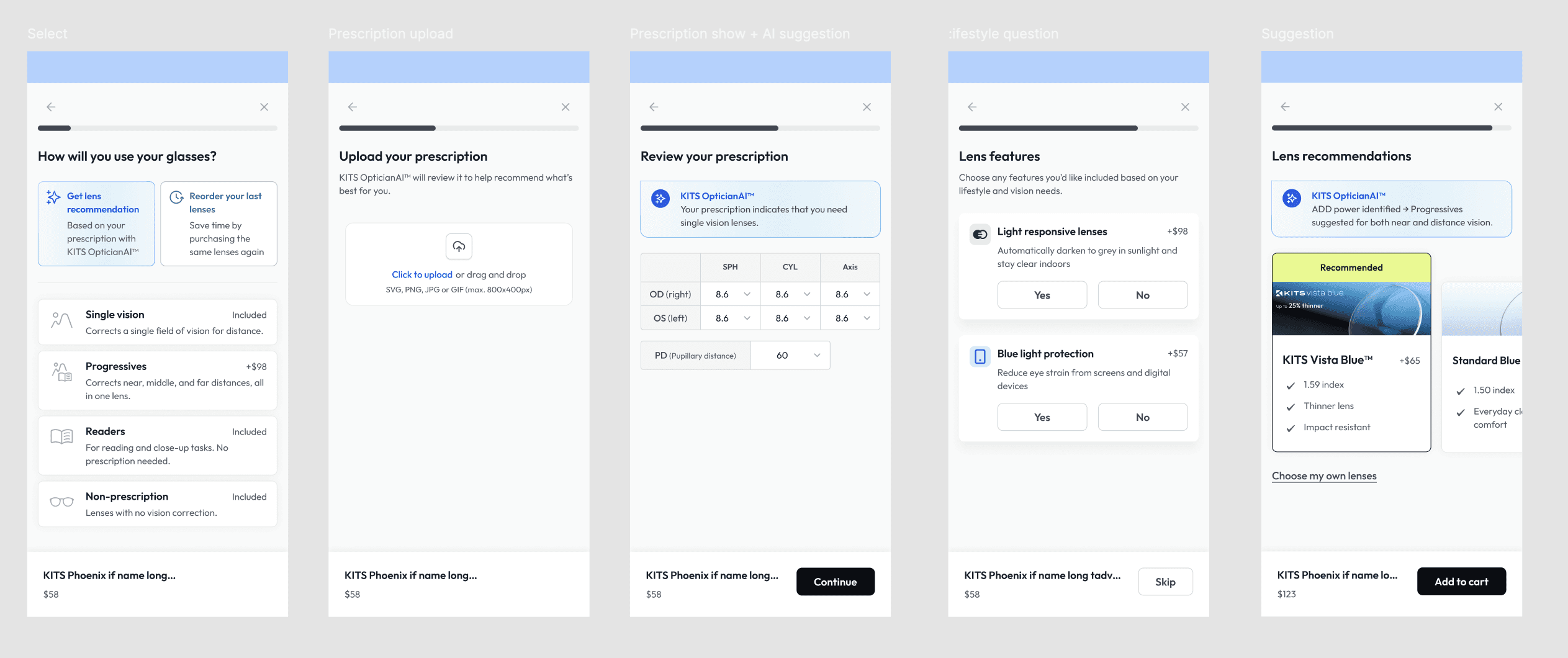
Instead of presenting a menu of options and asking customers to choose, the recommendation flow takes their prescription and stated intent and returns a specific recommendation.
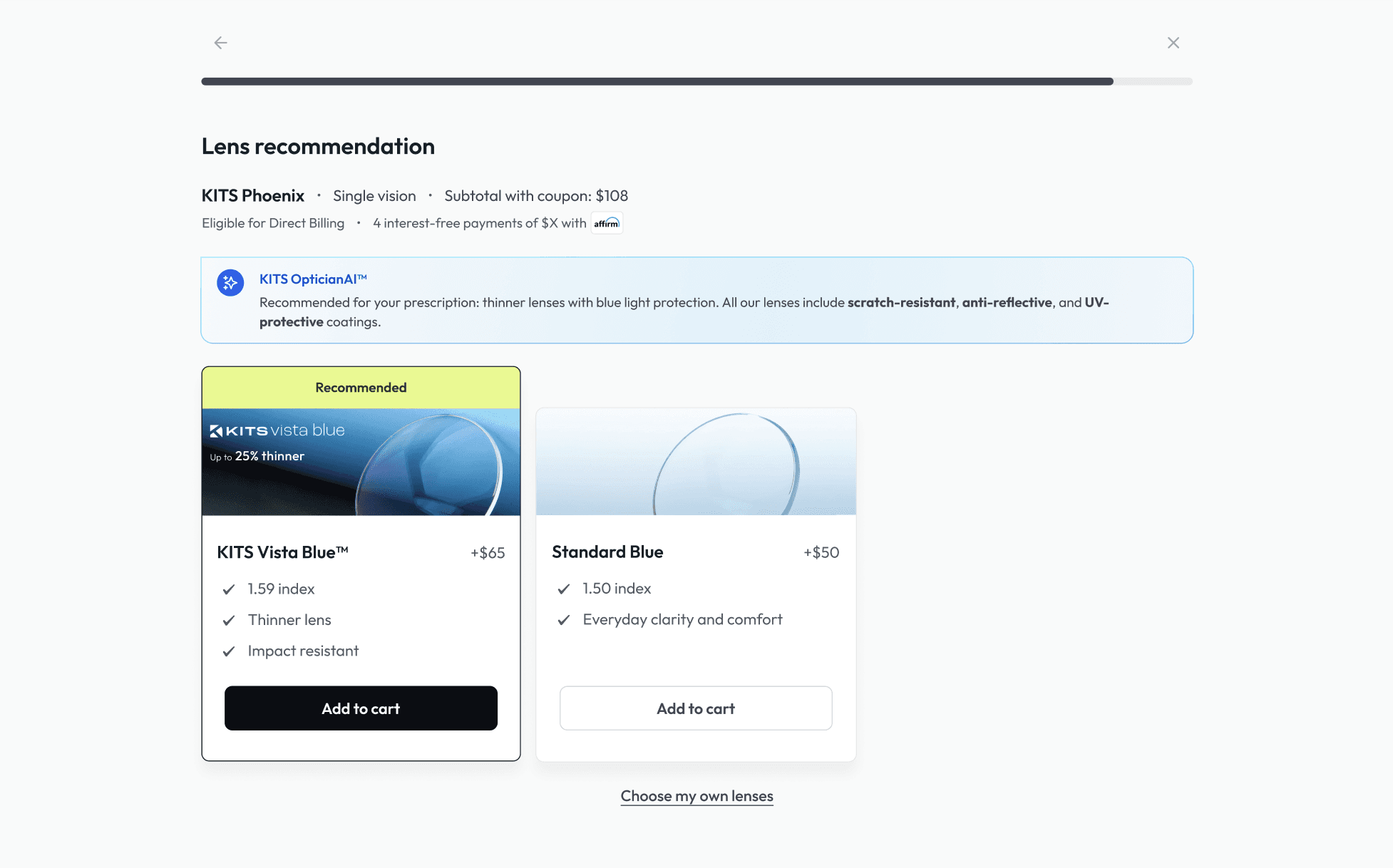
The challenge wasn't building the logic. It was making the recommendation feel trustworthy rather than algorithmic.
The reasoning leads, the recommendation follows. An early version led with the recommendation alone. In iteration, customers wanted to understand why before they trusted the outcome. The final design surfaces the reasoning first, so by the time customers see the recommendation it already feels earned, not arbitrary.
"Choose my own lenses" is always available. The AI is guidance, not a gate. The manual path is accessible and clearly labeled. It doesn't require customers to dismiss or reject anything. It's there to help, not decide.
The PD edge case system
PD (pupillary distance) is one of the most commonly missing values in customer prescriptions and one of the most consequential to get wrong. Rather than treating missing PD as a single problem, the redesign handles it in three tiers based on prescription strength.
SPH 0 to ±2.5: Lower prescriptions are less sensitive to PD variance. The flow applies an estimated PD transparently and lets the customer continue without interruption.
SPH ±2.75 to ±4: Mid-range prescriptions need a measured PD for accurate centering. The flow surfaces a guided measurement tool and explains why it matters, without blocking completion.
SPH ±4.25+: High prescriptions can't be fulfilled accurately without a verified PD. These customers route to direct optician support, framed as a service moment rather than an error state.
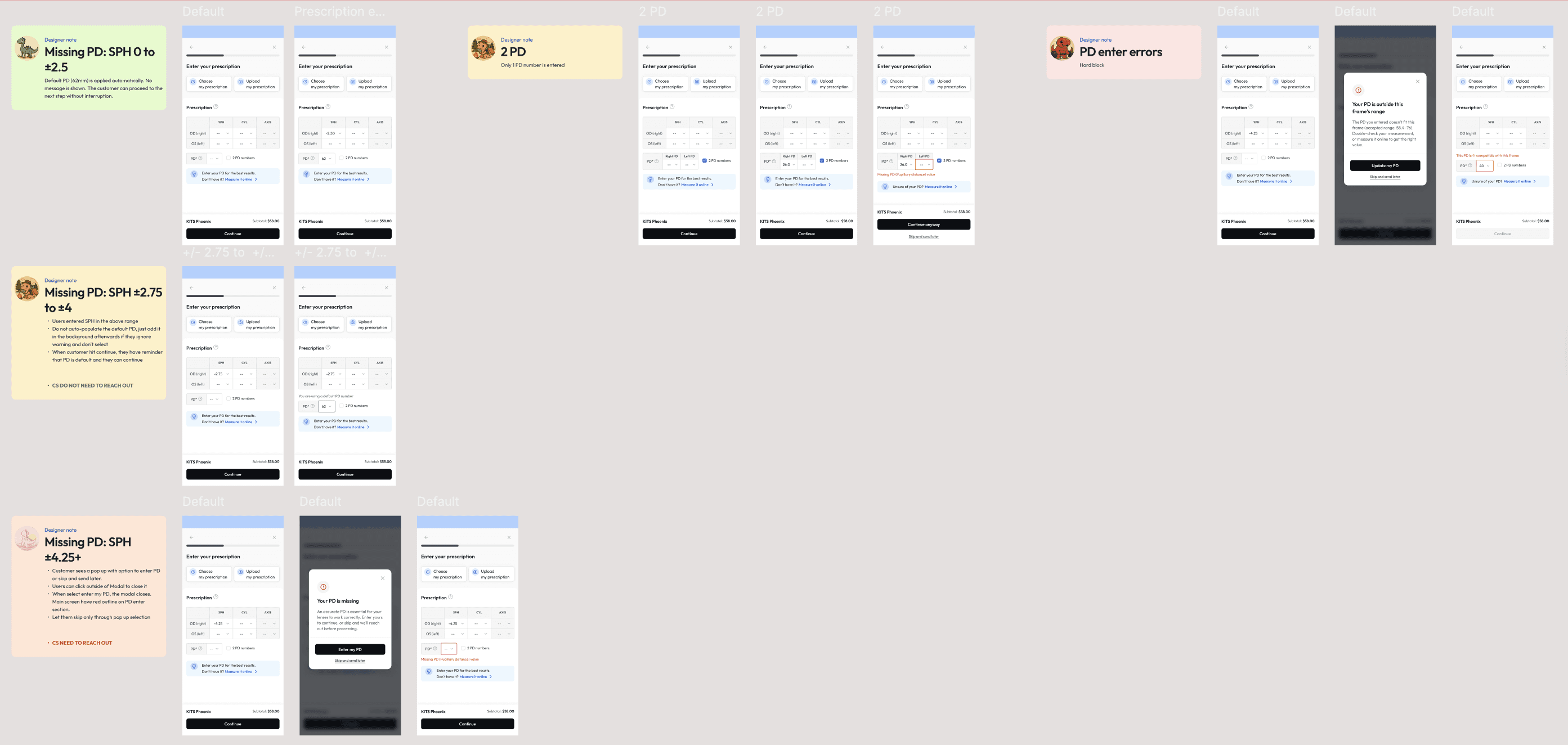
A -1.00 SPH customer and a -6.00 SPH customer have genuinely different needs. The flow treats them that way. Designing the edge case with the same care as the happy path is what makes the whole system trustworthy.
Impact
Launched February 26, 2026. Results from a controlled A/B test on KITS.ca (Feb 26 to Apr 26, 2026) and post-launch funnel data through April 2026.
A/B test: with vs. without AI recommendation
Lens upgrade rate: 71% vs. 43%, a 28-point lift
Average order value: +7.0% ($169.45 vs. $158.35)
Revenue per session: +7.3%
Exit rate 6.7 points lower in the AI-assisted flow
The lens upgrade rate is the number that matters most. The AI recommendation changed which lens customers chose, not just whether they converted. That's because the recommendation is grounded in their actual prescription, not a generic upsell.
Post-launch funnel
Lens flow entry: 18.9% to 26.9% in the first full month after launch (+42%)
Add-to-cart: +6.4 points (66.0% to 72.3%)
Transaction rate: +9.1 points by April 2026 (73.4% to 82.5%)
Higher entry rates and higher conversion rates at the same time tells me the redesign worked at both ends of the flow.